Saturday, February 12, 2011

Hang Fer Lo, the "Delmonico's" of 19th Century San Francico Chinatown


"Hittell's Handbook 0f Pacific Coast Travel," by John Shertzer Hittell had this account of San Francisco's leading Chinese Restaurant in 1885:

The Hang Fer Low Restaurant, on Dupont street, between Clay and Sacramento, is the Delmonico's of Chinatown. The second floor of this and other leading restaurants is set apart for regular boarders, who pay by the week or month. The upper floor, for the accommodation of the more wealthy guests, is divided into apartments by movable partitions, curiously carved and lacquered. The chairs and tables, chandeliers, stained window panes, and even the cooking utensils used at this restaurant were nearly all imported from China. Here dinner parties, costing from $20 to $100 for half a dozen guests, are frequently given by wealthy Chinamen. When the latter sum is paid, the entire upper floor is set apart for their accommodation, and the dinner sometimes lasts from 2 P. M. till midnight, with intervals between the courses, during which the guests step out to take an airing, or to transact business. Among the delicacies served on such occasions are bird's nest soup, shark's fins, Taranaki fungus (which grows on a New Zealand tree), Chinese terrapin, Chinese goose, Chinese quail, fish brains, tender shoots of bamboo, various vegetables strange to American eyes, and arrack,(a distilled liquor made of rice). Champagne, sherry oysters, chicken, pigeon, sucking pig, and other solids and liquids familiar to the European palate, also find their places at the feast. The tables are decorated with satin screens or hangings on one side; the balconies or smoking rooms are illuminated by colored lanterns; and Chinese music adds to the charms of the entertainment.

Hang Fer Low was located at 713 Dupont Street (now Grant Avenue) prior to the Great Earthquake of 1906, and moved to 725 Grant Avenue after the quake. Somewhere along the way the spelling of the name was changed to the risible Hang Far Low, and in the 1950's, perhaps tired of the low humor the name engendered, it changed its name to the Four Seas. It still exists today, but has long been overshadowed by other Chinatown restaurants.

Friday, December 24, 2010

Dumpling Kitchen -- Pretender to the Dumpling Throne?

I haven't been doing my homework; otherwise it wouldn't have taken me two and a half months to discover a new Shanghainese restaurant out in the fog belt claiming dumpling royalty. It wasn't until Jonathan Kauffman's review that I discovered Dumpling Kitchen, named modestly enough in English, but called 一品包餃王 in Chinese, which translates to something like Number One Grand Poobah of Making Dumplings.

The smallish room formerly housing Han Goeng Seafood on Taraval was slammed at lunchtime on Christmas Eve, and the din filling the room was predominantly Cantonese. According to Kauffman's review, the chef at Dumpling Kitchen is a veteran of Shanghai Dumpling King on Balboa. Sure enough, as I was being seated at the only empty table, a two-top at the back, I spotted a plate of what looked like SDK's signature sugar puff pastries floating through the crowd. I ordered xiao long bao, of course (my chief mission being to check them out) and sheng jian bao. The prices were certainly reasonable ($6.00 for ten XLB and $5.50 for eight SJB). However, the xiao long bao were something of a disappointment, oversized and sloppy in construction. The skins were supple enough, and the minced pork filling of the right texture, but the essential "soup "was characterless and oddly sweet. In addition, the vinegar dipping sauce was somehow off; I'd swear it was cut with soy sauce.

The sheng jian bao were also a disappointment. To use an Irish Bull, I'd say they weren't as good as I expected, but then I didn't expect they would be. Compared to street food-worthy sheng jian bao in Shanghai, they were undercooked on the bottoms, and seriously lacking in fatty broth. This seems to be almost universally the case in the US (and Canada), where apparently SJB are treated as if they were supposed to be healthy eats, instead of the drizzle-down-the-chin fat bombs they are meant to be.

Dumpling Kitchen has a fairly full menu of Shanghainese appetizers and xiao cai to check out at humane prices. There may be some gems on the menu, but xiao long bao and sheng jian bao aren't among them. In his review, Jonathan Kauffman suggested that the xiao long bao at Dumpling Kitchen might be in the sweepstakes for best xiao long bao in San Francisco. For what it's worth, I'd peg them at no better than fourth, behind Shanghai Dumpling King, Shanghai House, and Bund Shanghai's XLB.

Dumpling Kitchen, 1935 Taraval at 30th Ave., San Francisco

Tuesday, October 19, 2010

Poster Bao for San Gabriel Valley Dumplings Hails from San Francisco

I post a lot of pictures, largely food-related, to flickr. They're licensed as Creative Commons - Attribution, which means that anyone can use them for any purpose whatsoever as long as they acknowledge the source. Sometimes the emphasis is on "creative" in their use. A picture I took of zeppole being sold at an Upper West Side street festival in Manhattan showed up in a popular magazine's online feature on ballpark food -- representing the food sold at Yankee Stadium. The French onion soup I photographed at Au Pied de Cochon in Montreal ended up at a similarly named restaurant in Paris, a SF Japantown noodle shop ended up in Tokyo, and Torta Loca in San Francisco's Mission District found new fame posing as one of the best places to eat in Acapulco.

In general, I've adopted a "don't ask, don't tell" policy toward location misrepresentation of my photos, as long as my phony name is spelled right. The latest instance, however, of a referential head-fake involving one of my pics is so egregious that it almost borders on chutzpah, especially in light of the historic SF-LA rivalry (which I'm always happy to stir up). I have to call you on this one, LA Weekly.

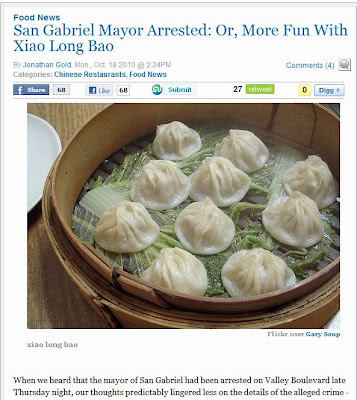
In the article depicted and linked above, the redoubtable and award-winning Jonathan Gold (he's a writer, not an apple) uses juicy political gossip as a hook for strutting about some of San Gabriel Valley's juicy dumplings, known to us cognoscenti as xiao long bao. The article goes so far as to dub a San Gabriel mall as the "the U.S. epicenter of the soup dumplings called xiao long bao" and was headed by a column-width photo by yours truly of some of the most photogenic dumplings ever to appear on the face of the earth.

Well, Jonathan (and I know the photo selection is not your bad), I don't do LA, and therefore can't call you on the excellence of San Gabriel Valley soup dumplings. I haven't been to LA in decades, and certainly not since my 1992 xiao long bao epiphany in Shanghai. What I'm getting at here is that the mouth-watering dumplings in the picture you honored by using it in your article cannot be found anywhere near San Gabriel. The picture was taken of the dumplings at Shanghai Dumpling King in the foggy outer Richmond District of San Francisco, the venue most loved by Bay Area xiao long bao aficionados. They're real, and they're spectacular.

Come up and try them some time.

Sunday, August 15, 2010

Biang! Biang! You're Fed

Biang biang mian, a.k.a. you po che mian at Xi'an Famous Foods, Flushing

[This article has also been posted in my Full Noodle Frontity blog]

"Biang Biang" noodles are the stuff of folklore. Not because of the dish itself (though it deserves to be legendary) but because of the very name. The word "biang" is a Shaanxi localism not found in any modern Chinese dictionaries, famous for its complexity. It is written with 57 strokes, and pity the poor sign-maker that has to paint it twice. No one knows for certain where the name originated, but the most plausible guess is that it represents the sound of the noodles being slapped against the work surface when being made. This theory is advanced by Xi'an Famous Foods' Jason Wang in this video. Biang Biang noodles, being "as wide and thick as belts" are also famous for that reason as one of the "ten strange wonders of Shaanxi." But don't look for "Biang Biang" noodles on your menu; although phonetic substitutes like 棒棒麵 (bàng bàng miàn) or 梆梆麵 (bāng bāng miàn) may sometimes be used, according to Wikipedia, the dish is most commonly listed on menus outside of Shaanxi as you po che mian (油泼扯面).

You po che mian, roughly "oil-sprinkled torn noodles" are wide wheat noodles tossed (or stirred) with chili oil and some or all of: bean sprouts, crushed garlic, chili flakes, cabbage, and cilantro. The noodles are made by tearing wide strips of noodle dough in two lengthwise, rather than iteratively pulling them to thinness as done with "hand pulled" noodles (la mian). Traditionally they were supposedly made more than an inch thick and a meter in length, but fortunately are found in a more manageable size nowadays. Biang biang mian/you po che mian is an excellent hot weather dish, hard to find even in China outside of Xi'an. If you're lucky enough to be in New York, though, head for the nearest outlet of Xi'an Famous Foods for the excellent version depicted in the photo at the top of this page.

Monday, June 28, 2010

The Now Bao: Four Postmodern Pork Buns


A year ago, I knew little about gua bao, the Taiwanese steamed clamshell buns stuffed with savory meat. When in New York my mind would be set on their distant cousin, the rou jia mo found at Xi'an Famous Foods in Flushing, the split-open pan bread with yawning maw stuffed with an explosive mixture of lamb, cumin and jalapeños. Then came another New York visit and the ritual of treating my daughter to a trendy, but always ethnic, restaurant meal as a reward for use of her apartment. This time it brought us to Momofuku Ssäm Bar. At Momofuku you have to try the "pork buns" the buzz went, and so we did.

The pork buns you get at Momofuku Ssäm Bar are not your father's pork buns and maybe even not your father's gua bao. They were envisioned by one David Chang, a Korean-American who has parlayed a large cooking talent, hype, and a sense of location, location, location into a mini-Momofuku empire, with his signature pork buns as a touchstone at each location. Chang's venues charge a momofukin' fortune (sorry, couldn't resist) for their offerings, and his pork buns have been taken note of both by imitators with dollar signs in their eyes and by other cooks who feel challenged to make something better or more authentically Taiwanese. The spawn of Momofuku's pork buns dot the haute Asian Fusion landscape; collectively, they involve a more or less traditional folded-over steamed bun, pork belly of some provenance. and various approaches to spicing (generally including sweetness). I've had occasion to sample three notable successors as well as Chang's original, and here are my reflections.

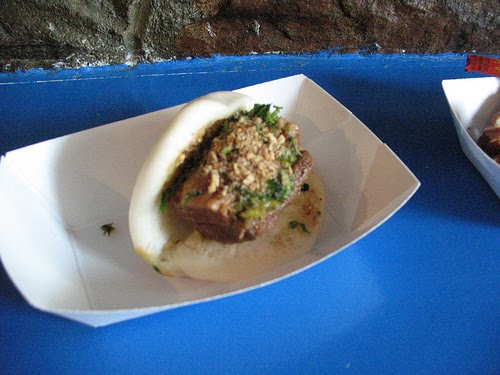
From the start, David Chang's pork bun is an odd duck. Or pig. Or both. A couple of slabs of slow-cooked pork belly, along with scallions and pickled cucumber are placed in a bun which has been slathered with hoisin (haixian) sauce. The intent was apparently to combine the trendy excess of pork belly (the culinary gift that keeps on giving) with the luxe experience of eating Peking Duck. I'm not opposed to sweetening the meat, being married to a Shanghainese of some coooking skill, but I found the use of hoisin sauce for this purpose a bit jarring. Just what the hell was I eating? Not only was this gustatory head-fake a bit uncalled for, it was also dearly bought. At $9.00 for two smallish buns it fell off the value scale, according to my felicific calculus. (But I'll leave the ranting about Momofuku's prices to others.)

One who seems challenged to one-up rather than imitate David Chang is Eddie Huang, the Taiwanese-American chef and former lawyer who founded Baohaus New York: Fresh off the Boat. Arguably in the same talen league and even brasher than Chang, Huang has also just opened the more ambitious Xiao Ye, the second outpost in what may be his own mini-empire (the Momofuku for the rest of us?) Huang skyrocketed to fame with his gua bao selections (cited as Best Bun in New York by New York Magazine). His take on the pork belly gua bao, The "Chaiman Bao," became his most popular item and incidentally launched a transcontinental controversy which is yet to be resolved. Eddie's Chairman Bao uses a generous hunk of pork belly (mine seemed leaner than Momofuku's) which has been "red cooked" in what I recognized as traditional Shanghainese style, made Taiwanese by being covered with with crushed peanuts and red sugar. Pickled mustard greens and cilantro add to the complexity. Not only did I appreciate the fuller symphony of flavors and textures, I found Baohaus' bao a better value, $4.00 for a palpably more generous portion of leaner meat.

A few months after Eddie Huang's baos, including the Chairman Bao, propelled him to casual food stardom, a food truck called "The Chairman Bao Truck" began serving gua bao on the streets of San Francisco. The Chairman Bao Truck was a concept which sprung full-blown from the head of a company called Mobi Munch (who later claimed to never have heard of Eddie Huang and his Chairman Bao). According to SF Weekly, Mobi Munch was founded "to offer turnkey infrastructure and development planning to the growing wave of gourmet food trucks." The founders, veterans of the chain restaurant industry, tried unsuccessfully to interest several local gourmet street food vendors in their service, then came up with the Chairman Bao Truck and populated it with a chef-operator named Eric Rudd (from Minneapolis, but with some local cooking experience). As might be expected, the mercurial Eddie Huang went ballistic over the use of the Chairman Bao name. I've shared his anger, but am trying not to aim it at the hapless operator, who is caught in the middle.
The affair will end in a sporting, if not completely amicable way with a bun-off between the two enterprises in September in San Francisco.

I caught up with the Chairman Bao Truck's pork bun last Friday night at Off the Grid at Fort Mason Center. It was the cheapest (at $2.95) but also the smallest of nouveau gua baos that I'd tried to the moment. It contained grilled pork belly, pickled daikon and pickled sweet onions. It was more discreetly spiced (NO hoisin sauce) and, though texturally monotonous, a well-behaved disciple of Momofuku's pork buns, though not as interesting or as satisfying as the Baohaus version. On a previous visit, when they had no pork buns on offer I tried the meatball and the tofu buns, and I'd actually recommend the tofu bun of the three.

The last of my four samples, encountered barely two hours ago, came from the opening lunch service of Spice Kit, a new San Francisco Financial District venture which looks like a winner. Fred Tang's gua baos are truly on the tiny side (indeed, they are listed on the menu as sides) and are $2.95 for one or two for $5.00. But the mighty mites, so round, so firm, so fully packed with grilled pork belly deserve to be upgraded in size or quantities to mains (which, for the record, includes Banh Mi, Ssam and salada). What hoisin sauce was present (and the menu claims it was there) kept a discreet distance from my palate, letting the flavor of pickled cucumber and scallions come through, and the firmer texture of the grilled (rather than slow-cooked) pork belly made for a nice contrast to the steamed buns. I made a meal out of my two mini-buns by adding an order of not particularly memorable ginger slaw and amazing house-made lotus chips. Who knew lotus root could taste so good?

Overall, as is probably is clear from the above comments, I prefer the gua bao from Baohaus NY for its flavors, textures, value and attitude. But I also have to give a nod to the porky munchies at Spice Kit, certainly my surprise of the week so far, and I wouldn't toss the pork buns from Momofuku or The Chairman Bao Truck into the compost barrel if they were handed to me. But to tell the truth, if you laid out all four next to one of Lao Liang's rou jia mos at the Golden Mall, hmmm......


Tuesday, May 11, 2010

Xiao Long Bao Mecca's Faded Glory


Note: an abbreviated version of this post originally appeared in the blog of the Asian Art Museum.

The steamed dumpling known as xiao long bao, described so evocatively by Olivia Wu on the Asian Art Museum's website, is synonymous with Shanghai, and for generations of Shanghainese eating xiao long bao was synonymous with a visit to one particular establishment, the Nanxiang Mantou Dian (Nanxiang Steamed Bun Restaurant). Here, in the historic Yu Garden area of Shanghai, in a second-floor dining room overlooking the nine-turn bridge and the mid-lake teahouse of blue willow China pattern fame, whole feasts are made from nothing more than stacks of dumpling-filled bamboo steamers, accompanied by small bowls of a thin soup.

According to local lore, xiao long bao were created by Huang Mingxian, in the Shanghai suburb of Nanxiang, around 1861. Huang owned a pastry shop and also hawked large steamed buns in a nearby classical garden. It was a competitive business, and Huang, with his pastry-making skills, came up with the delicate, thin skinned xiao long bao to distinguish his wares from the other vendors’, creating an instant sensation.

Their fame spread beyond the confines of Nanxiang, and in the year 1900, a relative of Huang’s named Wu Xiangsheng brought them to Shanghai, taking over an establishment named Changxing Lou. He perfected the delicacy, renamed the restaurant the Nanxiang Steamed Bun Restaurant, and booming Shanghai introduced xiao long bao to the world.

On a cool, misty day in early April 1992, I had my first ever meal on Chinese soil – a brunch consisting of xiao long bao at the Nanxiang Mantou Dian. My host Daisy (she’s now my sister-in-law) decided that the quaint snack shop that had hosted the likes of Queen Elizabeth II and Fidel Castro was a suitable introduction to Shanghai, and it is testimony to her judgment that I have been xiao long bao-mad ever since. The timing of our visit there was fortunate, for when we attempted to return three weeks later we found it closed for an extensive remodeling and reconfiguring as a more tourist-oriented enterprise. The dining area was expanded from a single room to three on two upper floors, and a takeout window added on the ground floor, and therein lies a melancholy tale; it's become obvious to xiao long bao aficionados, including yours truly, that the quality of The Nanxiang's XLB has fallen off significantly since that time.

The fall from grace of the Nanxiang Mantou Dian's xiao long bao is particularly noticeable in the thickness of the wrappers, especially when compared to the creations of the new standard bearers like De Long Guan, Jia Jia Tang Bao and Shan Wei Guan (see my earlier Xiao Long Bao Report Card). My theory is that the takeout window is the culprit here. When you order from the takeout window, your dumplings are unceremoniously dumped from a steamer into a paper boat, and of necessity are made with industrial-strength wrappers to avoid breakage from this rude treatment. The veritable xiao long bao factory on the ground floor (which you can observe through the windows) also makes the XLB for the main dining room on the second floor, so it's not surprising you are getting takeout-grade dumplings there, too. The more expensive third floor dining room has its own xiao long bao chefs, but even there the offerings seem to reflect both lowered expectations and a horror of breakage, coming with wrappers that are more delicate than downstairs but still thicker than they were in the glory days. My rule of thumb is that if at least one in a dozen doesn't break under a too-casual lifting, the maker isn't pushing the envelope (or the wrapper,as it were), and depriving you of the real xiao long bao miracle.

The Nanxiang Mantou Dian is now owned by a holding company listed on the Shanghai Stock Exchange, and has added additional branches in Shanghai and more than a dozen franchises in other Asian countries. Although xiao long bao connoisseurs will warn you that its dumplings no longer meet the gold standard the restaurant itself established, locals still revere the Nanxiang as the Mecca of xiao long bao and flock there to jockey for tables; the street-level takeout window, where the dumplings are still a proletarian $1.80 for sixteen dumplings, draws hour-long lines.


Sunday, January 24, 2010

Lanzhou La Mian Part II


In an earlier post, I documented my love for the Lanzhou Zheng Zong Niu Rou La Mian shops which can be found all over Shanghai (but especially the one on Hainan Xi Long). As promised, Here is a bit more of the science and history of this saving dish.

Making hand-pulled noodles requires an exceptionally supple dough; in practice this is usually achieved by the addition of kansui (jiang shui, or 鹼水), an alkaline solution of potassium and sodium carbonates, or a powdered base for same. Historically, however, the noodles were actually made supple by kneading lye from wood ash directly with the wheat flour. According to this article, "lye-kneaded wheat noodles" have been found in only three places in the world: Lanzhou, Gansu province, China; Chiang Mai, Thailand, and Okinawa. This practice probably was developed in China and introduced to the other two venues by Hakka travelers. Lanzhou is the only place in China where the practice persists. There, the lye is derived from burning mugwort grasses (peng cao) in a hole and extracting solidified rock-like mugwort ash (peng hui , 蓬灰) by a dripping method. The traditional use of peng hui can be seen in this video.

Lanzhou beef noodles as we know the dish is said to have originated with Ma Baozi
(马保子,1870-1955), a member of the Hui nationality, in Lanzhou at the end of the Qing Dynasty. He first sold his noodles of the street, and achieved such fame fame for thier tastiness that in Lanzhou they became known as "Ma Baozi Beef Noodles." In 1919 he opened his first "bricks and mortar" shop. Today, there are around 1,000 beef noodle shops in Lanzhou. The traditional characteristics of Ma Baozi Beef Noodles are said to be "one clear, two white, three red, four green, five yellow" (一清、二白、三红、四绿、五黄), a reference to clear soup, white daikon radish, red chili oil, green cilantro and yellow noodles. (The use of an alkali imparts a yellowish tint to the noodles, which use no egg.)

I'm indebted to Sunny's Sohu Blog for the picture of the Ma Bao Zi restaurant at the top of this page. I learned a lot about Lanzhou and the background of Lanzhou la mian from her post. Please visit it for more tempting photos of the restaurant and its wares.

Thursday, December 31, 2009

Happy New Year, and another Xi'an Ming Chi update

I've been dilatory in updating my blog, and blame fragmented interests plus a twitter addiction; but I can't let the year end with a new post and a hearty Happy New Year wish.

My 2009 noshing highlights are pretty well covered in the blog and here's the outlook for 2010: First and foremost, if plans materialize, I may be relocating to New York by the end of the year and will have one, two, many Xi'an Ming Chi analogues to discover in its five boroughs. Failing that (or supplementing it, if the plan comes to fruition), I will make a more resolute effort to track down some far-fuing San Francisco and Bay Area diamonds in the rough that I have heard rumours of. And of course, come hell or high water, I will work in at least a month in Shanghai, which calls me, Expo 2010 or no.

Now for the Xi'an Ming Chi update. As readers of this blog will probably have figured out, my favorite hole-in-the-wall for Chinese small eats outside of China is Xi'an Ming Chi, or Xi'an Famous Eats, in a ramshackle basement mall in downtown Flushing, New York. I have previously blogged about it here and here. The photo at the top of this post is of the shop's famous Liang Pi, a cold wheat-starch noodle dish which, as I discovered, is the perfect hot-weathyer lunch.

As of my last visit to New York, Xi'an Ming Chi had opened a second outlet, in the more conventional Flushing Mall food court, with no diminution in the quality of the food. Now comes news of a third branch, opened just this month, in Manhattan's Chinatown. According to coverage by the Village Voice and Serious Eats, the food is apparently up to the standard of the original, and thus presents an option for those without the time or inclination to head out to Flushing, though I can't imagine anyone not wanting to visit this little corner of China. The new branch is at 88 East Broadway #106, New York NY 10002 (at Forsyth Street).

Wednesday, October 21, 2009

Chop Suey: Chinese Cuisine's Prodigal Son

Chop suey was nothing less than the poster child for Chinese-American food in the mid-Twentieth Century. Iconized in art (Edward Hopper) and song (Flower Drum Song), it was also the signature offering of many Chinese-American restaurants, judging from their signage, which displayed "Chop Suey" more prominently than the restaurant's name. The origins of chop suey have been extensively studied by Jacqueline Newman (at least two articles in Flavor & Fortune Magazine), Jennifer 8 Lee (The Fortune Cookie Chronicles) and by Andrew Coe in a new book named, yes, Chop Suey: A Cultural History of Chinese Food in the Unided States, among others. Although evidence has been uncovered that chop suey has an antecedent in a south China dish named za sui ("mixed remnants") consisting of stir-fried chicken gizzards and other offal, something in our collective psyche seems to want it to be of American invention, our contribution to global Chinese cuisine. Several different stories have been cited to validate chop suey's American invention, the most accepted of which revolves around a traveling Chinese statesman named Li Hongzhang, of whom more below.

In researching another Chinese culinary mystery, namely why Anhui cuisine is named as one of China's "Eight Great Culinary Traditions" I kept coming across references to a dish named "Li Hongzhang Hotchpotch." This dish is usually listed as one of the four or five landmark dishes of Anhui cuisine, and one source describes the dish as follows:

Li Hongzhang hotchpotch is a popular dish named after one of Anhui's famous personages. Li Hongzhang was a top official of the late Qing Dynasty (1644-1911 AD). When he was in office, he paid a visit to the US and hosted a banquet for all his American friends. As the specially prepared dishes continued to flow, the chefs, with limited resources, began to fret. Upon Li Hongzhang's order, the remaining kitchen ingredients were thrown together into an impromptu stew, containing sea cucumber, squid, tofu, ham, mushroom, chicken meat and other less identifiable food materials! Thus appetites were quenched and a dish was created.

"Li Hongzhang Hotchpotch," it is immediately evident, is the very dish we call "chop suey." So, an obscure dish with humble origins in China is reinvented and achieves fame abroad as the ultimate in adaptive cuisine, and then the land of its reputed creator is proud to welcome it home and bask in its reflected glory.

Go figure.

Tuesday, October 13, 2009

Did the Chinese invent the Turducken?


If you've listened to football broadcaster John Madden around Thanksgiving, or even if you haven't, you may know about "turducken." That's a mashup of the words "turkey," "duck," and "chicken" and the name of an over-the top Thanksgiving specialty. The turducken consists of a turkey stuffed with a duck, which is in turn stuffed with a chicken, all of the creatures having been first deboned. The chicken, in its turn is also stuffed with some form of conventional stuffing. According to the Wikipedia entry for turducken, this delicacy was apparently invented in Louisiana, possibly even by the legendary Paul Prudhomme. One shop in Louisiana prepares around 5,000 turduckens per week around Thanksgiving, and they are even available by mail order.

Surely such a monument to meat could only be born in America, or some other Western nation prone to fresser excess, right? Well not exactly. As every wise person knows everything originated in China, and could turducken be any exception?

While searching recently for information on the eats in Zhengzhou, Henan Province (where a friend has invited me to visit), I came across references to "taosibao" (套四宝), or "four treasures wrap." This was not some kind of Chinese burrito but, according to an introduction to the food of Henan I found on the web, a dish that existed at least as long ago as the Qing Dynasty:

The dish is famous for integrating chicken, duck, dove and quail that represent strong, fragrant, fresh and wild flavor respectively. The four birds are combined with the bigger containing the small ones, which are as a whole without any bone. Being placed in a fine pottery soup bowl with blue patterns, the dinners can only see a whole duck floating in the soup. After eating up the delicious duck, they will find a fragrant whole chicken. Eating up the chicken, they will again find a delicious whole dove in front of them. Finally, they will find a quail which is also as a whole and stuffed with sea cucumber puddings, shredded fragrant mushroom, and water - soaked bamboo slice.
Well, it's not exactly a turducken, as no turkeys were apparently to be had, but the dish outdoes a turducken by having four birds telescoped into one instead of three. If a turkey had been available, you can rest assured that it would have formed a fifth layer of a "套五宝."

How does a taosibao go down? According to the same article, "
The dish contains several tastes, is neither fatty nor greasy and is tasty and refreshing. The customers praise that the course is strong, delicious, and nutritious so that the aftertaste is continuous." In other words, it's a gift that keeps on giving.

Thursday, September 10, 2009

On Dog, Guinea Pig and Real Pig (Not you, AB)

Persons with reservations about the practice of eating dog in Asia are probably not tinfoil hat-wearing PETA regulars, vegans or even anti-red meat. Their often expressed concerns are that a creature nature intended as a pet and a friend is ending up on someone's dinner table. But what if they had it backward?

Dogs are the descendents of wolves, and according to a recent New York Times Article, a new study of dogs worldwide suggests that wolves may have first been domesticated for their meat. The study, performed by a team of geneticists at the Royal Institute of Technology in Sweden lays out the story. Based on samples of mitochondrial DNA from dogs all over the world, all dogs appear to have come from a common lineage, and that lineage appears to have originated in (where else?) South China more than 10,000 years ago. Timing and other factors (including lack of a plausible alternative motive, I suppose) suggest that the purpose of muzzling, caging and breeding wolves was for meat for the dinner table, or whatever they ate on in those days.

Continuing the subject of edible pets (or pettable edibles, if you will), I blogged sometime ago about a modest proposal for Peru to export cuy, a.k.a. guinea pig, to China. Cuy is a delicacy in Peruvian cuisine, the country is currently producing more than they can eat and, as I explained, introducing the delights of cuy to China would partly repay Peru's culinary debt to China. This blog post, which included a picture of a cutie of a guinea pig, drew an avalanche of comments (well, four at last count). One of these comments is worth repeating here:

I'm an American married to a Peruvian living in China. I love cuy and would be ecstatic if I could order one off a menu here in China!!!

My wife's grandmother raised her own cuy (so she could feed them only the best) until she passed away, and they tasted amazing.

Incidentally, my wife and I run two small restaurants (www.snowymtncafe.com) for tourists here in the foothills of Tibet, and we serve a sampling of Peruvian dishes. I would add cuy to the menu tomorrow if we could find any!

Eugene, the author of the comment and his Peruvian wife Cindy operate their restuarants in Xiahe and Langmusi. According to their website, their menu offers:

Chicken Quesadillas
Homemade French Fries
Pizza w/ lots of Cheese
Spaghetti Bolognese
Lomo Saltado
Bistec a lo Pobre
(Peruvian Style Steak)
... & Tons of Local Dishes

Next time you're in Xiahe or Langmusi stop in and yak it up with Eugene and Cindy to and let me know if cuy has made it to the Himalayas yet. Even if not, enjoy the rare opportunity of enjoying lomo saltado with your momos.

As for the "real pig" in the title to this blog post, it has to do with Anthony Bourdain, and no, I'm not calling him a pig.

As I noted in an earlier post, Lao Liang's Xi'an Ming Chi at the Golden Mall in Flushing was to be included in Anthony Bourdain's No Reservations TV series on September 7, and as promised, I monitored Bourdain's visit on the edge of my seat. Before I comment on the subject, I need to do some penitence.

In the past I've been anything but a Bourdain fan, for reasons that are no longer important, and have not been shy about letting people know it. However, after watching the Outer Boroughs episode, and before it (once I found out where the Travel Channel was on my cable dial) the 2009 San Francisco episode, I have decided that AB is, at this stage of his and my lives, a mensch, and that we are really soulmates. The politics of food have become as polarized as electoral politics these days, and Anthony and I happen to sit on the same part of the foodie spectrum, the place for real people who like real food (note the lower case initials), distant from foodies who breathe correctness and gorge on labels like "sustainable," "organic," and "humane," which have no direct relationship to tastiness. What I once thought was Bourdain's schtick has become a stick to beat Alice Waters with, and I like that.

So where does the pig come in? Overall, I thought the New York Outer Boroughs segment was excellent, and happy to see Bourdain enjoying the well-known "lamb burger" (roujiamo) at Xi'an Ming Chi and giving Lao Liang's place some strokes. The only nit I would pick was that he didn't have time to try anything a little more out there, such as the notorious "lamb face salad," which you can take as literally as you like. However, Lao Liang was up against another stall in the Golden Mall which featured a bounty of golden fried pig offal, and who could blame Anthony Bourdain from being seduced and, er, pigging out on those before he even reached Lao Liang's stall?

Sunday, August 30, 2009

Lao Liang's Got His Roujiamo Workin'!


In a blog post from last year I wrote about the delights of the Xi'an specialties at a food stall in a ramshackle basement food court in downtown Flushing, and of its personable creator, who calls himself Liang Pi. In two trips back to New York this year (a brief one in April and a two-week stay this month) I made trips early and often to his venue and am happy to report that Lao Liang has his mojo (make that roujiamo) workin'. Since my 2008 visits, the Xi'an Ming Chi stall have been featured in various media from the New York Times to China Central Television; received visits from the likes of Anthony Bourdain (more on him later) and Zhang Yimou; expanded his operations to a second outlet in the shinier (but less soulful) environs of the Flushing Mall on 39th Street; started a slick little website where you can check out his menu; and acquired a Facebook Fan page!

On my 2008 visits to Xi'an Ming Chi I was too preoccupied with trying all of the stall's hot noodle options that I never got around to trying the dish Mr. Liang is so proud of that he named himself (and his new outlet) after, Liang Pi. This cold noodle dish, made from wheat starch noodles mixed with bean sprouts, kaofu and other condiments and drenched in a complex spicy sauce is pure dynamite for hot weather eating, as I well found out this month when the temperature hovered around 90 degrees F with high humidity for most of my stay. I'm also happy to report that it travels well as takeout, since they package the sauce separately for you in a plastic bag. It made the 20-minute trip on the 7 train back to Long Island City from Flushing on a couple occasions with flying colors. (Well, the colors, mostly red, fly when you pierce the plastic baggie and hose the cold noodles with its contents; it's as satisfying as opening a hydrant on a 95 degree day.)

As readers of my blog know, I am not a big Anthony Bourdain fan, especially after his Shanghai segment two years ago. However, I will certainly be watching No Reservations on the Travel Channel on its September 7 debut, because that's when AB will be featuring New York's Outer Boroughs, and his visit to Liang Pi's Xi'an Ming Chi is slated to be shown. If Bourdain gives Lao Liang and his food its due, he will have redeemed himself for taking the fall (in my esteem) in Shanghai.

Thursday, July 23, 2009

Lanzhou La Mian -- Part I

On my periodic tours of Shanghai, I'm usually on a mission to visit as many different far-flung notable small eats establishments as I can get to, which means very few repeat visits. However, when I reviewed my notes for my April stay this year, I found (not surprisingly to me) that I had visited one restaurant no less than 10 times in the space of a month. This restaurant happened to be a noodle shop of the "Lanzhou La Mian" stripe, Lanzhou Zheng Zong Niu Rou La Mian (兰州正宗牛肉拉面), roughly translated as "Authentic Lanzhou Hand-pulled Beef Noodles."

Why so many visits to this shop? For starters, it was just steps from the apartment hotel I stayed in. It was also open early and late (7:00 AM to 4:00 AM), was extremely inexpensive, and its products were tasty and filling. Thus, if it were raining (which it often was), if I were late getting around and famished, or just too plumb lazy to go further, it was there; but most of all, I had come to love the noodles from this shop from my previous visit in October 2008.

Shanghai has some 250 "Lanzhou La Mian" styled restaurants, judging from the listings in dianping.com. About 50 of these, like the one across from my hotel, are "official" Lanzhou La Mian Shops, with identical names, identical signage, identical menus, identical prices and more or less the same modus operandi: although there is a kitchen at the back of the shop, the noodles are made when ordered at a work table at the front of the shop, and passed, when finished, through a sliding window into a large pot of boiling water on stove set up outside. After all, who wants large pots of boiling water inside an un-air conditioned restaurant in a Shanghai summer?

In addition to the beef noodles, Lanzhou La Mian establishments will also offer lamb (but no pork, being Muslim and halal) noodles. In addition to pulled noodles they will have knife-shaved noodles (刀削面), lamb or beef pao mo (泡馍), or hand-torn steamed bread in soup, and other non-noodle and non-soup foods characteristic of the Lanzhou region. Despite this fairly extensive menu, the hand pulled beef noodles are always the main attraction, but don't go for them because you are a beef-eater. The thin beef slices, along with generous sprigs of cilantro are little more than garnish for the fresher-than-fresh noodles in a skillfully complex broth. A "small" bowl (enough for a hearty lunch) will set you back 4 yuan (about 60 cents), while a dinner-sized bowl if 5 yuan (about 75 cents).

It's notable that although the name and the origin of the specialty noodles come from Lanzhou, Gansu province, more often than not the Lanzhou La Mian restaurants are operated by Hui nationality Muslims from neighboring Qinghai Province. The history (and science) behind Lanzhou La Mian, and the development and popularization of today's bowl of beef hand-pulled noodle soup by one Ma Bao Zi in the early 20th Century, are fascinating subjects that will be touched on in a subsequent post.

Saturday, May 02, 2009

Xiao long bao report card update -- Lin Long Fang and Fu De Xiao Long


I'm just back from another month-long foray into the streets of Shanghai, which constitutes a major part of my excuse for not having posted in so long. I vowed not to get hung up on tracking down additonal xiao long bao venues to add to the reports I filed last fall in order to do justice to a broader sample of street foods and xiao chi, which I will be reporting on in due time; however, I couldn't resist checking out a couple of very different, but worthy new XLB venues I caught wind of.

The first of these, Lin Long Fang Te Se Xiao Long Bao (麟笼坊特色小笼包), or Lin Long Fang for short, had been open for less than a week when I visited it, judging from the earliest reviews of it on dianping.com. It has the look of a Jia Jia Tang Bao Clone; from the layout of the place, the content and pricing of the menu, to the bandana headgear worn by the small army of young women (yes, young women exclusively) making the baozi, it's Jia Jia with a different color scheme, brown in place of red. Even the Jia Jia trademark of steaming the vinegar dish along with the xiao long bao is here. Fortunately, they've succeeded, or very nearly succeeded, in cloning the Jia Jia xiao long bao. They seemed to me to fall faintly short of Jia Jia's mark in wrapper suppleness and flavor intensity of the soup, but otherwise they were very good, perhaps a B+ in my grade book. Lin Long Fang is also conveniently located (10 Jianguo Dong Lu, near Zhaozhou Lu) and it a bright, upbeat venue I'll gladly return to.

The other new (to me) xiao long venue I tried, Fu De Xiao Long was very much the opposite of Lin Long Fang. It was a proverbial hole-in-the-wall in a working class Hongkou neighborhood, and looks like it has been there forever, though judging from the vintage of the earliest dianping.com reviews has only been around for about a year. I'm tempted to say that Fu De is a cross between Fu Chun and De Long Guan, but I won't; it does share the same comfortable, weathered neighborhood ambience of those two, however. Like De Long Guan, the xiao long bao came in a small quantity (six baozi) for a small price, 4 Yuan (about 60 cents). I found the wrappers a little on the heavy duty side, however, and the "soup" at once a bit t0o sweet and too salty. I'll give Fu De's XLB a B. An added bonus to a visit to Fu De is the presence, immediately to the east on Dongyuhang Lu, of a very lively, blocks-long street market, where you can fand a seemingly endless array of street foods and wares for sale. You can find Fu De at 862 Dongyuhang Lu, about four blocks south of the Linping Lu Metro Station on the No. 4 line.

Sunday, March 22, 2009

Butterfly Effect: Erma Yina, the Blogger, the Movie, the Earthquake and the preservation of Qiang culture


In August of 2004, a tourist took a snapshot of a beautiful young Qiang woman named Erma Yina and posted it on his personal blog. The photo touched other Netizens, resulting in a flood of Chinese tourists to Taoping Village, Sichuan where the girl was photographed, and a flood of more pictures and national celebrity for Erma Yina followed. As a result of the girl's Net-driven idol status, a movie was shot in Taoping, "Erma's Wedding," short on plot but very long on local color.

On May 12, 2008, the Wenchuan earthquake all but wiped out Taoping and Erma Yina's birthplace of Li Xiang and threatened the future of Qiang culture.

Probably influenced by the Internet-spurred celebrity of Taoping Village and its famous resident Erma Yina, approximately 10 billion yuan (US $1.5 Bn) of investment from China and abroad has been allocated "to save and rehabilitate the quake-threatened Qiang culture."

The movie, "Erma's Wedding," was recently released in an English-subtitled DVD in the "Follow Me Chinese" series which features, though not exclusively, movies of a high propaganda value. The movie is described as "A true record of culture and natural landscapes of Qiang ethnic minority before 5.12 Wenchuan Earthquake."

Wednesday, March 18, 2009

From Peru with love: Cuy on China's Tables?


Peru has borrowed more from Chinese cuisine than has any other non-Asian nation. Peruvian-Chinese "chifas" (whose name derives from chi fan, or "eat [rice]" dot the Peruvian landscape more than chop suey parlors ever did the U.S. landscape. It's said that even non-Chinese restaurants in Peru have a variety of wonton soup as a standard menu offering, and lomo saltado, which amounts to Peru's national dish, is said to be of Chinese invention. It goes without saying that Peru would like to repay China for its culinary largesse beyond her greatest conbtribution to China's larders to date, the potato.

Enter the cuy. As the intriguing blog Double Handshake explains, the cuy, better know in the English-speaking world as the guinea pig, is a favored delicacy in Peru:

The animals, which reproduce extremely quickly, are full of protein and low in fat. Cuy, as it is called in Peru, can be fried, broiled, roasted or turned into soup. Peruvians eat about 65 million guinea pigs annually.

It seems that modern breeding methods have produced more guinea pigs than Peruvians can eat, and export options are currently limited. Why not, wonders the blog (which covers both China and Latin America) interest China in adopting a new taste treat? It convincingly lays out half a dozen good reasons why cuy would probably catch on, including a catchy slogan “It’s keyi to eat cuy!”

To Double Handshake's list of reasons why it makes sense to export guinea pigs to China for human consumption, I would add another: precedent. A cuy, or guinea pig, after all, is just another rodent, albeit a cute one. A rat is a rat is a rat, and skinned and cooked (see the picture in the Double Handshake blog) a guinea pig looks remarkable like the end product in an earlier blog post of mine, Eating your way through the Chinese Zodiac. That gustatory delight started out as the uncute critter depicted below. I've yet to taste either, but perhaps another selling point for cuy might be the catch phrase "It tastes just like rat."

Tuesday, February 10, 2009

From the Shanghai Bites Archive: Bow-wow stuffed baozi creates controversy


[Note: I have decided to let my Shanghaibites.com website and blog expire, and am reprising selected posts here in the @GarySoup Blog. This one was posted on February 27, 2007 in Shanghai Bites]

No, this is not something Michael Ohlsson ("Weird Meat") missed. It's a Yankee-style hot dog place, and the weirdest thing about it is its location: the northeast corner of People's Square, near the Shanghai Urban Planning Exhibition Center. I tried the dog last December, when I took the picture. There seemed something not quite right about the bun, but otherwise it walked like a hot dog, talked like a hot dog, and looked like a hot dog to me. And I should add tasted like a hot dog.

The controversy, if it can be called such, relates to the graphic logo of the jauntily leaning dog. Others in the blogosphere have pointed out that it's a copy of the logo used by Top Dog, the beloved and venerable mini-chain in Berkeley, California. I think it has also been reported that the Mac Dog owner once worked at Top Dog for a few months. Is Top Dog complaining? Not that I've heard. Should they complain? Unless they are planning to expand beyond their three East Bay shops to Mainland China, I think not. After all, imitation is the sincerest form of flattery.


From the Shanghai Bites Archive: Bourdain Blows It


[Note: I have decided to let my Shanghaibites.com website and blog expire, and am reprising selected posts here in the @GarySoup Blog. This one was posted on August 5, 2007 in Shanghai Bites]

I was excited to hear that the latest installment of Anthony Bourdain's "No Reservations" had him in Shanghai, sampling local small eats. When I caught the re-run, though, I found it to be a huge disappointment. Although the episode was identified as "Shanghai," there was a scant 10 minutes or so of an hour-long blitzkrieg Long March to Shangrila, and it was stock travelogue stuff. AB at the Nanxiang Steamed Dumpling Shop, proclaiming their xiaolong bao product to be "the best dumplings in the world." AB stopping by Xiao Yang's for some shengjian bao (a.k.a. "fried dumplings"). And finally, the really exciting and titillating blip of Anthony Bourdain buying "stinky tofu" from a street vendor and representing that it was something new to him. Then poof, off to cormorant fishing (another travelogue yawner).

The Nanxiang is certainly photogenic in its setting and activity (as in the above photo), and deserves a visit simply because it's a shrine to xiaolong bao. But it was galling to see Anthony Bourdain, as has been done with almost every video tour of Shanghai before, hunker down with the local tourism boosters and agree with them on the party line that the Nanxiang's XLB are the best anywhere. True, they once were, but if AB's team did their research, he would know that the Nanxiang's culinary glory has faded and there are probably mom-and-pop shops making tastier, nore delicate-skinned xiaolong bao in almost every Shanghai neighborhood today.

Shengjiang bao from Xiao Yang's establishment and even chou doufu from street vendors are also covered in almost any guide book a visitor is likely to bring with him. But I forget, Anthony Bourdain's show is on the Travel Channel, after all.

Tuesday, January 27, 2009

Vetting Bund Shanghai con't.: Four very different thumbs go up for New Year's Day dinner


Expect the worst, but hope for the best, we like to say in the U.S.

A couple of posts ago, I embraced Bund Shanghai Restaurant tentatively, based on the imperfect nature of the breakfast fare I tried and/or of my sense of taste, then impaired by a head cold. Last night the Spring Festival gave me an excuse to take a flyer on it for dinner with my personal review panel in tow, they being three generations of very picky Shanghainese women in the persons of my wife, Mother-in-law and step-daughter. Coming in cold, as it were, with them, I was prepared to be both disappointed and scorned, but happily suffered neither fate: we all loved it from first bite to last.

I ordered conservatively, with the intent of getting a read on how well they did the Shanghai classics. We started with kao fu, five-spice beef and salty duck for cold dishes, followed by Yan du xian (see post below). pan-fried nian gao (also de rigeur for a Shanghainese New Year's feast) and hong shao rou (red-cooked pork belly), always a potential show-stopper. We added onion beef (on the request of my stepfaughter, whose tastes have become somewhat Americanized) and gambled on something called "Seaweed fish" from the Chef's Specials menu which sits in a little holder on each table.

The kao fu came first, and my MIL, the toughest critic of the bunch, led the chorus of praises for Bund Shanghai's version, which featured kaofu cut into smaller diamond shapes than usual, blanched Virginia peanuts and donggu (Shitake) mushrooms. The Nanjing salty duck was lean and appeared to have been freshly cured, showing no sign of refrigerator burn, dry edges or other discoloration. It was as good as I've had at Xiao Jinling in Shanghai, famous for its Nanjing duck. The five-spice beef was lean and tender shank meat, subtly spiced, not overpowered by five-spice powder as is often the case.

Yan du xian, a soup that eats like a casserole, is considered by some to be the most indispensible part of a Shanghainese New Year feast. It is listed on the Bund Shanghai menu as "Boiled Bacon and Pork Soup" and contains (for symbolic reasons) both cured pork and fresh pork, winter bamboo shoots and tofu sheet knots (bai ye jie). Bund Shanghai's version was comforting, rich, and salty. Some might find it too salty, but "salty" is part of its name and of its aim. The nian gao ("Rice Cake w/Shepherd's Purse and Shredded Pork) was the softest I've ever had, almost of melt-in-the-mouth tenderness. I wondered if this was a misfire, expecting a little more al dente character, but the three women were wowed by it.

The hong shao rou ("Soy sauce-braised pork" on the menu) was as unctuously appealing as only red-cooked pork belly can be, and Bund Shanghai's version did not commit the error of being too sweet. Hard to believe, but the owner told us that the house's red-cooked pork butt (ti pang) is even better.

The onion beef was unexciting to me, but the stepdaughter loved it and took the leftovers home with her.

The "seaweed fish" probably got the coolest reception, partly due to its unfamiliarity and possibly due to the fact that it came last, after we were pretty much stuffed. It turned out to be yellowfish filets that had been dipped in a thin, seaweed-infused batter and deep fried, then arranged on the plate to look like fish. "Not very good," said my wife, as she reached for another piece of it. I thought it was fine.

We finished with jiu niang ("Small Mochi in Rice Wine Sauce," as the menu put it), complements of the house. I abstained, because this dish is too sweet for my tastes, but my wife had no trouble eating my bowl as well as hers.

We spent time talking to some of the staff and found out more about the restaurant. The owner has been in the US from Shanghai for 20 years, and is an attorney with a private practice. He actually opened the restaurant create a livelihood for recently immigrating relatives. (His mother is the cashier, and a sister is the hostess).

There are two dinner chefs at Bund Shanghai. One formerly worked at the Jin Jiang Hotel in Shanghai, and the other worked as a chef for the Municipal Government of Shanghai (official functions and the like). We chatted briefly with the latter and found out he is actually from Wuxi, Jiangsu province, which made him a hit with the girls, who are Wuxiren as well). Both chefs had worked at various restaurants in the suburban Peninsula area before he recruited them to work for him, a reversal of the usual direction for talent drain.

Saturday, January 24, 2009

Yan du xian: Shanghai's Spring Festival comfort food


[Click on picture for source document and more pictures]

One of the first things I learned about Shanghainese people was that they all seemed to love a soup they called something like "EEE-tuh-shuh." It was something they might crave at any time of year, but was particularly important as a harbinger of Spring. It always contained both salted pork and fresh pork, and Winter bamboo shoots. Some versions, like my wife's, also contain bai ye jie, or knotted strips of tofu "sheet," and sometimes greens and bean thread will be added. It was some time before I figured out that "EEE-tuh-shuh" was the Shanghainese pronunciation for yan du xian (腌笃鲜). Here's how yan du xian was described in the only article I've ever been able to find in English, from a 2003 edition of the Shanghai Star:

With the Spring Festival (the Chinese Lunar New Year) drawing near, "Yan Du Xian" is again in the limelight. It was said that this course was the most necessary one on the dinner table.

Before 1900, peasants living in the suburban areas of Shanghai made their living by starting small businesses such as charcuteries. They raised piglets and sold the meat to the shop and the left-overs were usually cured into bacon which was hung high in corridors.

When bamboo shoots came out in the following year's early spring, local families took the bacon down and added it to some fresh meat and pieces of bamboo shoot.

The ingredients were placed in a large cauldron and cooked over a slow fire for a whole afternoon until it turned into a pot of delicious soup.

The pickling process is called "Yan" in the Shanghai dialect, the simmering is called "Du" and the fresh meat and bamboo shoots are called "Xian", giving the soup its name.

The usual recipe for this soup is first to stir-fry some ginger and shallots, add water and high-grade Shaoxing wine, boil the mixture then adddiamond-shaped slices of bacon, meat and bamboo shoots. Simmer on a slow fire for not less than two hours


Many festival foods in China are symbolic because of their names, which may be homonyms for, or rhyme with, the names for desirable things or qualities; since the pronunciation of words varies considerably among dialects, the symbolic importance of many such foods are not always transferable among regions and can sometimes be mystifying. The primal symbolism of yan du xiang, on the other hand, is fairly obvious, with the cured meat representing the previous year's bounty, and the fresh meat and especially the fresh bamboo shoots representing the promise of the new year.